Posted by: Richard Marshall | June 14, 2013

Shanghai

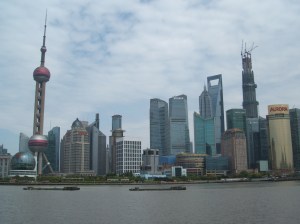
Pudong Skyline

Pudong Skyline

After nearly six months I guess I really need to write up what I have been doing in Shanghai. It’s been a pretty hectic few months-after being so established and familiar with Ho Chi Minh City it feels strange to still be so far from really being settled here. Part of the reason for that is that Shanghai is just so much bigger – a day on the bike could cover pretty much everything in HCMC, but here there are still popular expat and tourist areas where I haven’t yet been. Not having the motorbike of course reduces my independence a lot, and though the metro is good there are usually long transfers to get anywhere. I also spend more time at work than I did before and work further away from the city centre than I did even in Vietnam. But though I still feel like I’m finding my way, the city is spectacular, I’ve made good friends, my job is…ok, and generally I’m loving being in China.
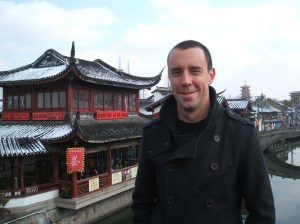
Me in the snow at Qibao old street

Me in the snow at Qibao old street

Arriving in winter was a bit of a shock to system after three years unbroken summer. The company I work for had us hitting the ground running – we were taken to a hotel, training began the next morning, we were helped to find an apartment and were working a normal schedule pretty much within two weeks. The job is fine. We teach lessons that are already prepared so there is not much original preparation. I don’t have my own classes as I did in Vietnam but teach whoever shows up for a particular class. This I guess is convenient for busy adults but is also a pity as I can’t monitor progress and build the same kind of relationships that I did with my Vietnamese students, though there are regulars who I have come to know quite well. It also sucks when I have teach the same lesson over and over again, as I do often. The students fortunately are mostly really nice people which makes the job a lot easier. The company is very much profit-oriented, and a lot of the time I feel like a cog in a corporate machine rather than an educator achieving much of value. There is a lot of management and they are for ever coming up with half-baked schemes, extra work and jargon-laden pronouncements from on high. But my colleagues and students are great and I do my job as well as I can so none of the rest of it really matters.

My apartment is a massive complex called Brilliant City. It is pretty much on the edge of central Shanghai. I am very comfortable here and it is convenient for work. Almost all my friends live within walking distance which is fantastic. Once my lease is up, though, I’d like to move somewhere more central. There aren’t really any good restaurants or bars nearby, and being on line 3/4 rather than line 1 is a pain, as the transfer to line 1 at Shanghai railway station – which I have to do for work everyday – is long, malodorous, and full of jostling migrant labours and homeless people sheltering. Ideally I’d like to move near line 1 or 2 in the future.

Keeping fit has been a bit of a challenge. I joined a gym for three months, but the spitting and smoking in the change rooms and the guys working out without shirts, shoes or towels eventually put me off the place. I’ve done a bit of running but still not regularly enough. I also bought a bicycle in the hopes of doing some exploring. So far my only trip has been up to Baoshan district to see the muddy, grey, smoggy mouth of the Yangtze river, which was cool but not really enough to keep me in shape. My progress in Chinese has also been disappointing so far – it’s fascinating but I’m just not finding the time or discipline to study often enough. Hopefully in the next few months I’ll start doing better…

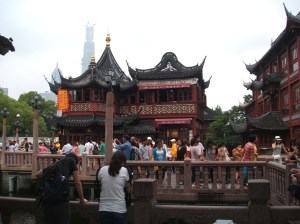
The city is really spectacular. My first destination on one cold wintry afternoon was the Bund, with its awesome neo-classical and art deco colonial buildings on one side, and the massive Pudong skyline across the river. It was pretty grey and bleak in winter, but now summer is here and all the trees are in leaf it is really beautiful. Just south of the Bund is the old city, which seems to be entirely in the process of being ripped down for tower blocks. The main attraction here is Yu gardens, which has a famous teahouse and is now surrounded by a garish bazaar and seems always to be heaving with tourists and touts. It’s pretty enough but really a bit overwhelming. Just west of the Bund is People’s Square. This used to be the old British race track but now it kind of a civic centre and park complex – the city hall, theatre, museum and Urban Planning Exhibition Centre are all here. The museum is lovely – it’s great to be reminded that China is an ancient civilization amongst all the crazy building going on around everywhere. For that, though, the Urban Planning Exhibition is tremendous. It has a huge scale model of the city’s central districts, including buildings like the enormous Shanghai Tower which are still under construction. Around People’s Square there are also some cool Art Deco and colonial buildings.
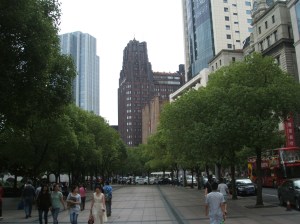
Park Hotel, People's Square

Park Hotel, People’s Square

Tea house and tourists at Yu Gardens
Tea house and tourists at Yu Gardens

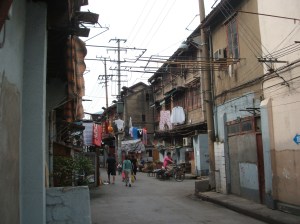
Old Town street

Old Town street

The former French concession is west of People’s Square. It has beautiful leafy streets, lots of Art Deco, fancy shops and great bars and restaurants. Some of my favourite spots so far, such as Shanghai Brewery, are here, but it’s also just nice to wander around and explore. Except for a trip to an old street at Qibao I haven’t been to any of Shanghai’s further-flung destinations. My only trip out of town so far has been to Huangshan, which hopefully I’ll write up next week. A friend of mine and I are headed to Hong Kong and Guangzhou at the end of the month which should be wonderful. After that I hope to do some more travelling, so hopefully I’ll write more often.
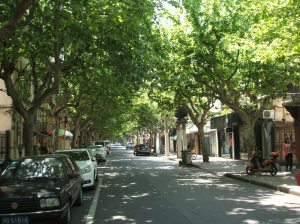
Leafy former French Concession street
Leafy former French Concession street
Posted by: Richard Marshall | April 15, 2013

Family Trip – and Tam Biet Viet Nam

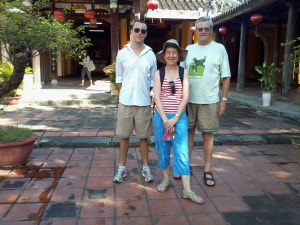
Mom, Dad and I in Hoi An

Mom, Dad and I in Hoi An

After three months in Shanghai I have managed to get a vpn which connects me back to social media. I didn’t particularly miss facebook – though I’m glad to have it back – but I was very unhappy not to be able to update my blog. That really was the reason getting the vpn was so important. I will write up my impressions of Shanghai so far in the near future, but first I’ll write up my farewell trip in Vietnam with my parents.

My parents had been to Ho Chi Minh city before so we only spent a night there – enough to have Pho with Ted, Cindy, Mike and Dung and to go to my favourite restaurant – Huong Cau – for a beery dinner. The next day we took a flight up to Da Lat. I have now been to Da Lat three times and it remains probably the nicest place I have been in Vietnam, or even Asia. In all four places we stayed we went back to hotels I had stayed in before – I think the receptionist in Hue was the only person who remembered me but they were all nice places and it was great to go back. The first day we wandered around the town checking out the usual places – the crazy house, the flower garden, the cathedral – and booked a walk in the hills for the next day. The walk was one I had done back in 2010 and was very nice. Dad and I managed to get some birding in and saw a few new species, but it very pleasant simply walking through the pines.

Birding in Da Lat

Birding in Da Lat

We had one more day to explore Da Lat so we checked out the railway station and Bao Dai’s palace and took the cable car to a pagoda by a lake, but Dad and I were in shorts so we didn’t go in. I might have mixed up where we went each day but we took it pretty easy. We managed to get a few beers at the cafe overlooking Ho Xuan Huong lake which is what had initially won me over to the town. We booked bus tickets for Nha Trang taking the provincial road which I had loved so much on my bike trip and it was indeed spectacular again. Nha Trang is a nice enough town, but the bar at the sailing club is really fantastic so we headed there for a few sundowners looking out over the South China Sea.

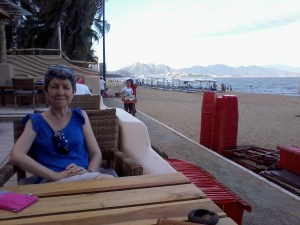
Mom at the Yacht Club

Mom at the Sailing Club

Dad really wanted to find a seafood restaurant that did good crabs so I used my Vietnamese with the hotel staff to get a recommendation away from the backpacker area. We took a taxi to the north end of the beach and found a really great place – big, open, no-frills and overlit but with cold Saigons, crabs, prawns and a great atmosphere. I showed off my Vietnamese again chatting with the manager and we had a really fantastic dinner. The next day we weren’t really sure what to do with ourselves so we headed to Vinpearlland – a resort/ theme park hugely popular with the Vietnamese but that I had thought I probably wouldn’t bother with myself. In fact it turned out to be really pretty cool. The oversea cable car to get there was wonderful and gave great views of Nha Trang’s skyline. I went on one ride and we wandered around. It was a pity we had forgotten our swimming costumes as it was hot and the water park looked really fun. We took the cable car back and found another beach-front restaurant for dinner.

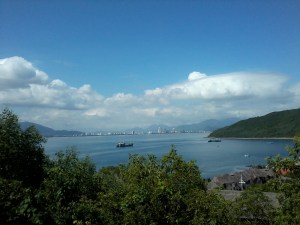
Nha Trang from Vinpearlland

Nha Trang from Vinpearlland

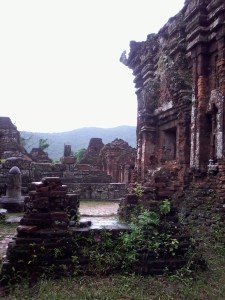
From Nha Trang we took a flight up to Da Nang and were picked up by our hotel to be taken to Hoi An. The hotel was one Gregor and I had stayed in and is very nice – the back rooms have balconies that look out over Rau Muong fields and Dad and I saw a couple of interesting birds lurking around. We had fantastic food in Hoi An as always – Cau Lao, white rose, spring rolls being my favourites. The town is charming and it was great just wandering around. The one day I hoped to meet my friends in Da Nang so Mom and Dad went up to Marble Mountain without me. In the end only Joe came down and I could have gone on the trip anyway. Joe, Dad and I had a beer when they got back. The next day though we all three went to My Son, the old Cham capital that I regretted I had missed in two previous trips to the area. Although horribly damaged in the American war – there some huge bomb craters in the complex – there were some attractive buildings remaining and it was very atmospheric in the mist and rain with the green hills surrounding the ruins.

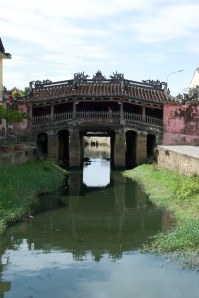
Japanese Bridge

Japanese Bridge

Dinner in Hoi An

Dinner in Hoi An

My Son

My Son

Birding in My Son

Birding in My Son

After Hoi An we headed up to Hue. Unfortunately the bus didn’t go over the Hai Van Pass, though the tunnel underneath it is pretty impressive. It was also a sleeper bus which was surprising and not hugely comfortable, but luckily it isn’t far. In Hue we visited the Imperial Citadel and managed to find some great meals. Sitting by the Perfume River one evening at a string of little restaurant stalls was especially nice, and I tried to find the best Banh Khoai in town, though none could match the one in Dong Hoi on my bike trip. Hue is one of my favourite places and it was nice to see the progress being made on the reconstruction. The second day in Hue we headed out to see Thien Mu Pagoda and the tombs of Gia Long, Minh Mang, Thien An and Tu Duc. I really love the Imperial tombs but unfortunately as the day progressed it became wetter and wetter so that by the end we were all soaked. I kept on slipping on wet, mossy bricks in the downpour. But at least we got to see Ming Mang’s tomb quite well as it is the most beautiful.

Hue

Hue

We spent Christmas day in Hoi An. We had a delicious but rather unusual Christmas Day lunch of steamed squid, mango salad and spring rolls. That evening, after several beers, we had to head back to Da Nang to catch the plane to Ho Chi Minh City. I had been under the impression I would arrive in China at the end of December so Mom and Dad booked tickets home on the 26th. It was only later that I found out I should arrive in Shanghai on the 10th of January. So Mom and Dad’s holiday was unfortunately cut a little shorter than it need have been. But we had a wonderful time and it was great to show Mom and Dad my favourite places and to bid farewell too. Thanks Mom for all the great pictures taken with her cellphone!

I was left with nearly 2 weeks to kill  so went and stayed with Shaun and Amy in Bangkok for 10 days. Ted and Cindy were in Thailand so we met for New Year.

I flew back to Ho Chi Minh City and, after three…tumultous…years in Vietnam finally said goodbye and headed to China…

Posted by: Richard Marshall | January 5, 2013

The Philippines

I finally finished at ila at the end of October, but my new job in Shanghai only begins in January so I have time for a couple of trips. My first was to the Philippines. I’d never really given the country much thought, but with only a couple of blank pages left in my passport Laos, the other country in the region I haven’t visited, wasn’t possible as it requires a full page visa. The Philippines only requires a stamp, though I had a brief moment of panic when the woman behind the Cebu-Pacific check-in desk looked at my SA passport as though it was from Yemen or North Korea. The flight was cheap but unfortunately arrived in Manila at 5am, so I had several groggy, sleepless hours loitering in Malate before I could check into my hotel. Malate is not the nicest place to find oneself at a loose end. Having been to a number of Southeast Asian cities I thought I was used to dirty, ugly streets and lots of sleaze but Manila really took me aback. The whole place was full of massage parlors and “ktv” bars, mostly apparently catering to Japanese and Korean tourists. My hotel was a weirdly straight-laced, Catholic island in this sea of vice but comfortable enough. There were also some very nice restaurants nearby so I managed to find a Filipino breakfast of garlic rice, fried egg and sweet marinaded pork before eventually getting a much needed rest. That evening I went to a nearby dive full of really seedy looking middle-aged men but which had cheap beer and delicious food – chicken adobo was the first dish that made me realize Filipino food is really good. I wandered around a bit but being constantly importuned by nasty looking pimps was a bit of a drag so I soon headed back. The next day I woke up feeling much better so decided to check out Manila’s tourist attractions. Sadly, the once beautiful city was completely devastated in 1945, so little remains of Intramuros, the city’s old core. Even in their ruined state, though, Fort Santiago and the city walls were attractive and evocative, and the churches and cathedral were imposing. After a morning wandering around here I’d had enough, so I went to the Mall of Asia and watched Skyfall in an imax cinema which was a very pleasant way to spend the afternoon.

Fort Santiago

Fort Santiago

San Agustin church

San Agustin church

Malate street

Malate street

The next day I headed down Luzon’s southern peninsula, a region called Bicol. My first stop was a town called Naga, where I hoped to arrange to climb Mount Isarog. This was the first of the dreadful bus journeys I endured during the trip, and although  the distance was about 350km it took nine hours and I arrived after dark. The next day was Sunday and the crowd who apparently arrange trips up the mountain were nowhere to be found. At a bit of a loose end I went to the Camarines Sur watersport complex. The place is famous for wake boarding, which involves standing on a surfboard-like thing and being dragged around a circuit on a cable. I didn’t worry about this, but swam some laps in their very nice pool and had a delicious lunch looking out over cloudy Mt Isarog. It was a close to the mountain as I got, however. It turned out I couldn’t arrange a trip, but could go up on my own if I was willing to get up a 3:30am, race up to the top and race down again to catch the last Jeepney at 5pm, which I decided I wasn’t. That night I found a very nice restaurant and tried a local specialty called Bicol Express –  a mixture of chopped green chilies, minced pork, shrimp paste and coconut cream, which was tasty but also a bit of a shock to the system. The next day I headed further south to Legazpi to try my luck with the Philippines’ most iconic volcano, Mount Mayon. Legazpi was a pretty dismal city, but I arranged a trek for the next day. That evening I went for a run along the seafront and for the only time saw the picture postcard view of the volcano across the bay.  The next day the clouds rolled in and I spent my two days on the mountain thrashing though an overgrown trail in intermittent mist and rain. I saw the ocean a couple of times and the summit not at all which was pretty disappointing. On the second day we eventually came to the wet, slippery ravine which was to take as near to the top as possible without oxygen (for the fumes, not the altitude – the volcano is still active) but the weather was so bad we decided to turn back. All the same, it was fun to get out and do some trekking in the bush so I’m glad I went.

Wet and misty Mount Mayon

The bus trip from Legazpi city to Manila was the worst of a number of awful trips I took. Although only about 460km, it took 14 hours. It was so agonizingly slow I thought I might be stuck in Quezon province forever. I was so exhausted the next day I couldn’t face getting on another bus and just loitered around Manila. The next day, though, I felt strong enough to face the six hours to Baguio. I was fortunate to be able to take a “deluxe” bus which was indeed amazingly comfortable – it even had wifi which occasionally worked. My initial impression of Baguio wasn’t great. It was the American summer capital and though one can see the outline of the cool, pleasant town that once existed war damage and unrestrained growth and development have left it a particularly polluted and congested city. The one place where it was still possible to get a sense of the historic town was the old US Marine base called Camp John Hay. It’s mostly been turned into a resort but a few old buildings remain with high ceilings and wide verandas where you could imagine Marine officers in starched khakis enjoying their sun-downers.

Camp John Hay, Baguio

Camp John Hay, Baguio

I had several drinks in a tired bar that evening so had to board the bus to Sagada with a foul hangover. Fortunately the scenery headed into the cordillera was so stunning I hardly felt it. The roads in the mountains are narrow and winding with steep drops on the side, and the slopes are thickly forested with beautiful pines.  Sagada turned out to be one of the nicest places I’ve been in Asia. The town itself is pleasant, with lots of little restaurants serving tasty food and truly fantastic home-made yogurt. The main tourist attraction is various groups of coffins belonging to mountain tribes hanging from cliffs, but to me the chance just to take long walks through the forest with stunning views was what made the place so special. I managed to see some interesting birds too. I was also lucky to get a great room at a discount in a hotel where the rooms were named after the apostles. I was glad to get Simon Peter rather than some also-ran like Thaddeus or Batholomew! I hung around for a couple of days before heading on to Banaue.

View of Sagada

View of Sagada

To get to Banaue I first took a jeepney to Bontoc. I rode on the roof which was a bit terrifying but offered  fantastic views of the mountains. After Bontoc I caught a bus to Banaue. The town itself was a much less attractive place than Sagada, but my hotel had a terrace which looked right out over the 2000 year old rice terraces which make the place famous. Although the terraces are impressive, they are bracketed by roads and pretty ugly strip development which I felt detracted from them a little.The next day, however, I went to see some more terraces a few kilometres away at Batad. Batad is a bit more remote – the village itself lacks road access and getting there involved a walk through gorgeous forest. I almost didn’t bother, but when I got there I was glad I had – the terraces running up the side of a steep hill were very impressive. I had lunch looking out at the view and then trekked back to Banaue.

Batad terraces

Batad terraces

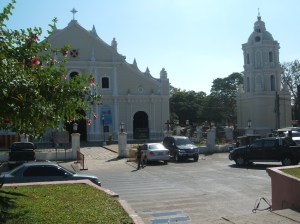
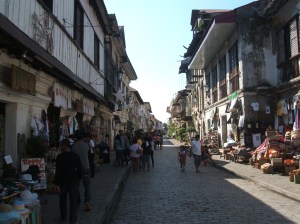
After Banaue I reluctantly had to spend another night in Baguio. It turned out to be a national holiday so I had to pay a small fortune to spend the night in a lousy hotel. I did however get to see a very impressive and elaborate advent parade which was a nice consolation. The next day I took another maddening 180km, seven hour bus ride to Vigan in Ilocos Sur. Ilocos province was quite dry and dusty and reminded me quite a lot of parts of Zimbabwe. Vigan is an old mestizo trading port that somehow escaped the destruction that has befallen most of the Philippines’ other towns. As a result it has beautiful cobble-stoned streets lined with old mansions that reflect a mixture of Filipino, Chinese, Spanish and Mexican styles. The bottom stories were mostly solid stonework, build for trade and storage, while the upper stories were spacious, high-ceilinged hardwood structures with capiz-shell windows. The cathedral was an imposing, “earthquake-baroque” Spanish structure. I was very lucky to be able to meet up with two friends from HCMC, Luke and Emily, and together we tried a few of the local specialties such as deep-fried belly pork, and a  great many of the local beers! The three of us spent our last day nursing pretty dreadful hangovers but it was really fun all the same! The next day Luke and Emily headed up to the cordillera and I had one last, appalling 13 hour bus trip to Manila, followed immediately by an 11pm flight to Vietnam. I was happy to fall into bed at 2am and to have a few days to recover before Mom and Dad arrived in HCMC. The trip was really fascinating though – and Luzon is just one island of 7, 107! The Philippines is definitely a country I’d like to return to…

Vigan Cathedral

Vigan Cathedral

Vigan street scene

Vigan street scene
Posted by: Richard Marshall | August 17, 2012

Vietnam Bike Trip, Part III: The North

The North

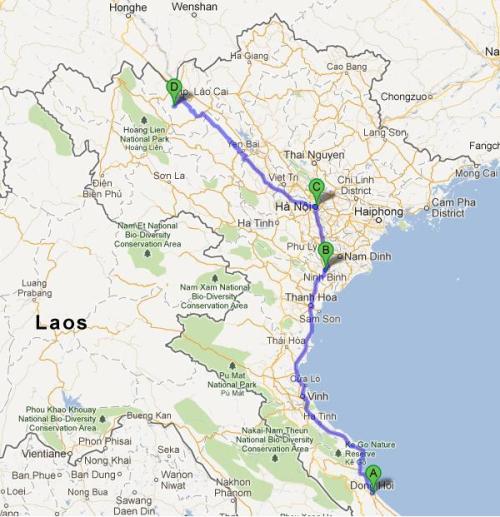
After getting my bike repaired in Dong Hoi, I decided to try to push all the way to Ninh Binh. None of the towns in between seemed to have much to recommend them – the biggest was the dull, gritty port city of Vinh where I really didn’t want to have to spend the night. The distance ended up being 412km, the longest day’s ride of the whole trip. It took me out of Quang Binh province, clean through Ha Tinh, Nghe An and Thanh Hoa, and finally into Ninh Binh province itself. It was an utterly exhausting day, from which I actually didn’t quite recover for the rest of the trip. Long stretches of highway one are in really poor condition, and horribly dangerous  for a motorcyclist. What happens is a two lane road with a wide shoulder is built through sodden rice paddies but the weight of all the trucks causes the centre of the road to subside, raising a four-inch ridge between the road and the shoulder. Then they go and resurface the centre of the road but not the shoulder, turning the ridge into a cliff. In either case, it makes moving from the road to the shoulder nerve-racking. The way the buses, trucks and other vehicles drive it’s frequently necessary to swerve all over the place – on several occasions I was actually driven off the road by overtaking vehicles.  There’s clearly something about driving a tanker with 20,000 litres of aviation fuel that makes a person want to drive like a complete maniac – perhaps one day I’ll get a chance to try it. The road surface is potholed and uneven, so you need to be constantly alert. Often I was cruising happily at 70kmh and then suddenly had a crater under my front wheel. And then of course the clouds of dust and smoke leave your face and clothes literally blackened. So by the time I finally pulled into Ninh Binh I was filthy, shaken-up and aching all over.

Ninh Binh did, however, turn out to a pleasant enough town. It’s great disadvantage is that the highway runs bang through the middle of it, a horrible, deafening, smoke-choked scar rift between pleasant neighbourhoods on either side. Away from the highway, the town has a charm I found quite often in the north. The streets are narrow and tree-shaded, the houses, though newish, are soothingly painted in ochres and yellows, red chinese lanterns hang in the doorways, children play in the streets and the place has a feeling of community and continuity. The food was great – pho noodles with duck was a revelation – and, again typically for the north, there were many streetside bia hoi places serving cheap draft beer.

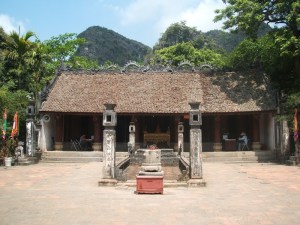
Ninh Binh has two claims to fame. There is an area of karst mountains and emerald green rice paddies that features highly on local and foreign tourist itineraries, and a couple of temples that are all that remain of Hoa Lu, one of the first Vietnamese capitals after independence from China in the tenth century. Like so many areas in Vietnam the whole place is under terrible threat. Ninh Binh is also a cement manufacturing centre so the edges of the karst are are literally being eaten away. More problematically the government has decided to build a massive tourist infrastructure in the area, meaning that the day after gasping my way over a truck-clogged, half-built highway I found myself exploring the hills…on a truck-clogged, half-built highway. I didn’t bother to visit the vast, new Buddhist complex at Bai Dinh which at least partially justifies the road building. I also avoided the tourist trap boat trip to yet another limestone cave at Tam Coc after having been so underwhelmed at Phong Nha. Hoa Lu, however, turned out to be lovely. The two temples are in leafy, shaded complexes under the shadow of the karsts, and retain a sense of antiquity which is so scarce in Vietnam.  A stroll away from the road behind the temples also finally revealed some of the stunning scenery that made the area so famous in the first place.

Karsts and paddies, Ninh Binh

Temple, Hoa Lu

Temple Entrance

After a couple of days I drove the 90-odd kilometres up to Ha Noi. I think it’s a pity I didn’t visit Ha Noi when I was fresh and rested. Perhaps getting off the plane and taking a taxi into town would have gotten me off to a better start than hauling my bike up a dismal highway after two and half weeks on the road and then getting lost in the labyrinthine, chaotic old quarter. As so often in Vietnam, I found Ha Noi to be a place with tremendous potential, but also under terrible threat. Ha Noi old town must once have been absolutely beautiful. It could be again, despite everything, if only the government could come up with a sound plan, efficiently and uncorruptly implemented, taking into account the needs of the people who live there as well as the cultural and economic importance of the city’s heritage. But this is Vietnam. I gather from the internet that there is all sorts of legislation, but rampant development and the ease with which developers buy off the government means that the area is being steadily degraded. The traffic is appalling, and because there are no street lights in the network of narrow roads bikes simply hoot as they approach an intersection. Protection is given to the very oldest houses, but early twentieth century ones, which actually make up most of the area, can be knocked down at will and replaced with the usual monstrous hotels, karaoke bars etc. Shopfronts are altered with terrible neon or plastic signage. I’ve seen other old towns in South East Asia – Singapore, Melaka, Hoi An and KL – and although they are very different from Ha Noi I felt that they must offer some guidance as to how to preserve that kind of urban fabric. All of this, in my tired state, made it tough for me to like Ha Noi.

Having said that, the noise and the chaos of the old quarter do give it tremendous atmosphere and vitality. The city is green and leafy and the lakes are indeed very beautiful. The government quarter, although cold, paranoid and forbidding as you would expect in a communist capital, had many gorgeous Indochinese mansions. The Temple of Literature, a tenth-century Confucian university, is one of the iconic symbols of Ha Noi and has wonderful charm even though it’s surrounded on four sides by seething highways. I drove out to the edge of the city where they are building the usual East Asian forest of half-empty skyscrapers to see Vietnam’s tallest building. I’m glad I’ve been to Ha Noi but will wait a decade or so before I go back. It will either be one of the most beautiful cities in Asia or it will be a hideous concrete jungle. I just hope they get it right…

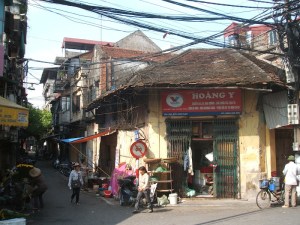
Old Quarter

Old Temple, Ha Noi

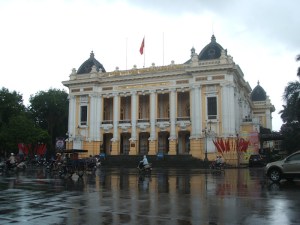
Ha Noi Opera House

Temple of Literature

Temple of Literature in the rain

After three days in Ha Noi I headed north for the last time. Highway 32 towards Yen Bai ran along the bank of the Red River. It was an attractive landscape of lush green paddies and villages nestled in trees. Yen Bai itself was another pleasant, green northern town, though it was impossible to find a decent cup of coffee here or anywhere else north of Ha Noi – not on the side of the road at any rate. The road from Yen Bai to Lao Cai was much less congested and in much better condition than I had expected, but wound up and down through the mountains making progress frustratingly slow. The mountains weren’t even that attractive as they had been extensively deforested. Eventually I found myself in Lao Cai as evening was falling. The town seemed to be completely devoid of street signs so I drove pointlessly around trying to find the road to Sa Pa. Even though it was getting dark I just couldn’t bear to be stuck in such an awful place, so I headed off anyway. As it was only about 40km or so I thought it would be quick, but I didn’t reckon on having to gain 1000m in altitude along the way. So I arrived in Sa Pa in swirling mist in the dark. I spent the night in a fairly wretched hotel, but moved the next day to somewhere much nicer. And friendlier. Finding out that I was traveling alone and could speak passable Vietnamese I was invited to party with the staff that involved trying to eat disgusting blood jelly and drinking endless shots of rice wine scooped out of a bowl with the shot glass. This limited my enthusiasm for anything too energetic the next day, so I just wandered around the town and took a short drive to a waterfall. The town is attractive enough, though not as big or as pretty as Da Lat. The mountains, though, are far more spectacular. It’s very touristy, and the Hmong, a local minority who are themselves one of the attractions, seem largely dependent on selling handicrafts to foreigners. There are plenty of pleasant places to eat or drink coffee, so I was happy just to read and relax. I stayed a couple of days, but soon the rain set in and I hardly saw the mountains again. It was still raining on the morning I was to leave. The same winding road was even more difficult in the mist and rain, and I was exhausted and sodden by the time I eventually got back to Ha Noi.

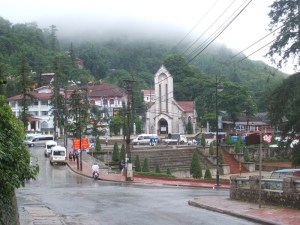
Sa Pa church

Sa Pa mountains

I wanted to get out of Ha Noi as quickly as possible, so I booked a ticket for the next night. The trip back to Ho Chi Minh City took 33 hours. The scenery was attractive and it was interesting to see water filled bomb craters next to every bridge and station. The people were also friendly if you didn’t mind every kid asking how you were and what your name was fifty times. But it was boring and I was glad when the train finally pulled into Sai Gon station. My bike was on a freight train and took a couple of extra days. It needed quite a few repairs but soon it and I were back to the usual HCMC routine. The trip was one of the most incredible experiences I have ever had, and one of the most adventurous. It was absolutely worth it.

Me on the bike, Sa Pa

Posted by: Richard Marshall | July 25, 2012

Vietnam Bike Trip, Part II: The Centre

The Centre

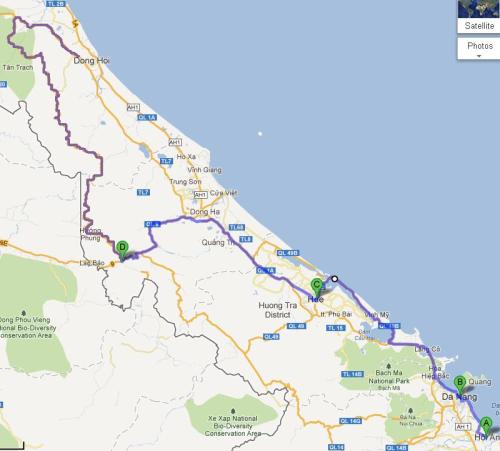
After spending an evening in Hoi An I took a leisurely drive up to Da Nang. Da Nang has a spectacular setting, with long, white sand beaches and the Truong Son mountain range looming behind. It is also one of Vietnam’s more attractive cities – the streets are wide, tree-lined and not overwhelmingly busy and the waterfront along the Han river has been done up nicely. There is some interesting architecture and a couple of impressive bridges. I met up with my friend John for a lunch which ended up extending long and boozily into the evening.  As a result, I was unable to do a great deal the next day. I found a greasy fried breakfast in a bakery owned by some sort of religious lot – it’s called “Bread of Life” – and me sitting there with a foul hangover no doubt lowered the tone of the place. That afternoon I went to see a movie and then went to bed early. The next day John and I drove down the long beach towards Hoi An where we had lunch in a lovely, relaxed restaurant over-looking the sea. It was great being able to meet up with a friend after so many days on the road alone and with so many more ahead.

John and me by the river

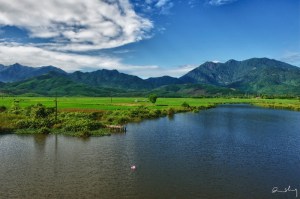
John and I had a nice dinner for my last night in Da Nang and though it wasn’t excessively alcoholic, I didn’t feel up to heading back onto the Ho Chi Minh highway and taking the long route to Hue. Instead I drove over the Hai Van pass as I had with Gregor last year, but got off highway one and took the provincial road running the other side of a large lagoon almost all the way to Hue. I didn’t actually see much of the sea. The road ran through sandy country with a few villages, thickets of scraggly conifers, and huge graveyards. The tombs were large and ornate and sometimes it felt like driving through a necropolis. I love the scenery in this part of the country. The landscape is quintessential Vietnam – dark mountains, emerald rice paddies cut by broad rivers and interspersed with snug villages and coconut palms. Even the houses seem less ugly than other parts of the country. Hue is also one of my favourite places, and I stayed a day to wander round the citadel and see how much progress had been made on the reconstruction projects.

Hue

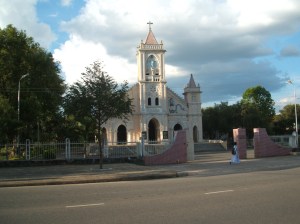
It’s possible to head west from Hue back to the HCM highway, but I decided to go north along highway one to see some of the iconic places of the American war – Quang Tri and Dong Ha – and then head west along highway 9 which runs roughly along the southern end of the DMZ. Quang Tri was a pretty dull place. It has the remains of a citadel but most of the city was flattened in 1972 and only a gate remains. Although most of the DMZ towns have been totally rebuilt there were a few buildings in Quang Tri that still had war damage and, like the church in Dong Hoi, are far more evocative war memorials than the socialist monuments manage to be. Highway 9 was a pleasant provincial road through mountains, forests and plantations. I arrived in Khe Sanh in the early afternoon and found a not excessively dismal guesthouse. I offloaded my backpack and, after some detours through coffee plantations, eventually found my way to what remains of the Khe Sanh combat base. Although the collection of rusting American tanks and helicopters and the dusty museum full of old guns and shells was standard, and the fitful efforts to rebuild bunkers to impress whatever tourists make the journey here was pretty tired, Khe Sanh did have atmosphere. It was hot and still on the dusty red airstrip and you could look up to the range of hills that so obviously dominate it and try to imagine the whole place burning with bombs and napalm. Other than an old guy trying to sell me dog-tags and two tourists who arrived as I was leaving, I had the place to myself.

War Damage in Quang Tri

Highway 9 and the DMZ

Khe Sanh

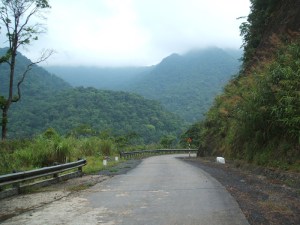
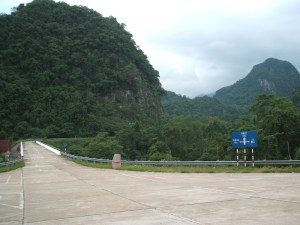
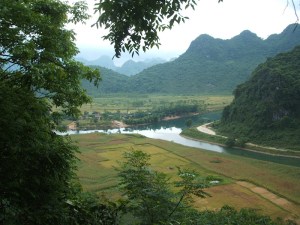
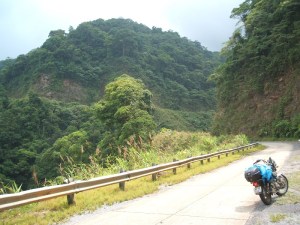
After Hue, the Ho Chi Minh City splits into two. The HCM highway east is a good, new road, intended to relieve traffic on highway one. The HCM highway west is a narrow, winding concrete road running through the mountains on the Laos border. I had been nervous about taking the western route – settlements are few and far between and my bike wasn’t wholly reliable – but in the end I decided just to go for it. The drive from Khe Sanh to Phong Nha was the high point and crowning achievement of my trip. It was simple an unbelievably, tremendously fantastic day. Initially I drove though areas that had been badly deforested, but the further I went the more remote the route became. It was overcast and mist swirled over the mountains and the forests. For long, long stretches I was utterly alone, winding up and down the concrete ribbon of the road. There were a few villages, fortunately, so I topped up with fuel and thankfully my bike held together. The last stretch of road ran through the Phong Nha – Ke Bang national park, a landscape of limestone karsts cloaked in jungle. The highway poses a terrible environmental threat to these mountains, but for now it’s still beautiful and remote.

Near the Laos border

Misty mountains

The bike and the road

More misty mountains

The jungle

After my fantastic day the town of Phong Nha was, unfortunately, something of let down. It was hopelessly dull. I checked into a very shabby guesthouse and tried to find something to eat. The long line of totally deserted  rice and noodle shops held little appeal. I had heard that there was a western-run backpackers near Phong Nha. Although I didn’t want to stay there – for ten bucks I’d sooner have a second rate room than a dorm bed – I decided to try get a meal there. After pointlessly driving around the countryside for some time I eventually phoned the place for directions. It was, as I had expected, kind of, well…douchy, but I got a backpacker-style burger, a couple of beers, and a few pissing contests with Aussies about who had been in Vietnam longest, driven furthest, traveled most etc. The next day I headed to the two large limestone caves which are Phong Nha’s main attraction and found then to be pretty underwhelming, though the karst landscape was stunning. I decided to get as far as I could up the HCM highway that afternoon. No sooner was I back in the mountains, however, than I noticed I was leaking petrol. I just couldn’t bear to return to Phong Nha so I decided to turn around and try make it the 50km south down the Ho Chi Minh highway west to Dong Hoi. My Lonely Planet claimed Dong Hoi was a pleasant beach town and so it turned out to be. It was totally destroyed by American bombing and the shattered ruins of the old church are a stark reminder. The local mechanic fixed the fuel tank with wire, superglue, ground-up incense and poly-filler, which incredibly held until I returned to HCM City. I had a nice dinner in Dong Hoi and a pleasant drive along the seafront. I was, however, only a few hundred kilometres north of Hue after three days on the road and starting to worry about time. I also didn’t want to spend any more nights inn towns like Khe Sanh or Phong Nha where I couldn’t even find a lively bar or restaurant.  The nearest town with any kind of tourist infrastructure was Ninh Binh, 400km to the north, so I decided to make a break for it.

Karst Mountains near the Laos border

Phong Nha landscape

Posted by: Richard Marshall | June 24, 2012

Vietnam Bike Trip, Part I: The South

The South

After a year of planning and dreaming about my bike trip through Vietnam I have finally done it. I bought a motorcycle, did a driving test to get a Vietnamese license, planned a month off work and was finally ready to go.  I’m going to write up the trip in three parts, starting with the the south – Ho Chi Minh City to Hoi An.

I left Ho Chi Minh City at four thirty in the morning.  Much as I dislike getting up in the dark and gulping down a cup of horrible instant coffee,  I needed to escape the city before the morning rush. The town immediately outside of HCMC, Bien Hoa, is a traffic-choked industrial eyesore and I certainly didn’t want to get stuck in a traffic jam there. Even at 5am highway 1A was full of trucks and buses kicking up huge clouds of dust and smoke. The one remarkable feature of Bien Hoa is the number of enormous, incredibly ugly Catholic churches, a result of a large Catholic influx into the town after 1954. Otherwise I was glad to get through the place as quickly as possible. Initially I missed the turn-off to highway 20, but after only a small detour I was on the road to Da Lat. I had a quick bowl of pho and was on my way. Although quite an important road, highway 20 was one of the worst roads I drove on. Most of Dong Nai province seems pretty dismal, though Cat Tien National Park is just off the main road so it can’t all be rubber plantations interspersed with dusty, crowded towns with pot-holed streets. Eventually the road wound into Lam Dong province and the highlands. The most interesting stretch of road was the Bao Loc pass into the mountains. When I went up in the bus two years ago there were a lot of road works, but now the road is in good condition and the steepness of the surrounding hills means they are still well forested.

Bao Loc Pass

After Bao Loc the stretch to Da Lat is mostly vast areas of coffee plantation which isn’t very interesting. Despite having gained quite a lot of altitude it was still incredibly hot, and it was the first and last day I forgot to smother my hands and face with sun-screen. Just outside of Da Lat I got onto one of those inexplicable four-lane highways with no traffic in the middle of nowhere that seems to be a feature of the Vietnamese countryside. Finally I rolled into Da Lat after 12 hours and 350km. I checked into the same hotel I’d stayed in two years ago and went down to the same restaurant to have a beer while a cool breeze blew in from the lake. Even after driving all over the country Da Lat remains my favorite place – the wide, leafy streets, the beautiful French architecture, the cool air and the pine-clad hills are utterly unlike anywhere else in Vietnam. I hung around the town for a day looking for French villas – I downloaded a history of the town on my kindle which had interesting chapters on the town’s architecture – and, after spending my last evening having a few drinks in a tourist cafe with a passable Filipino singer, headed towards Nha Trang on the coast.  Provincial road 723 between Da Lat and Nha Trang is brand new and mostly in excellent condition. North of Da Lat the landscape is hilly with small villages in the pine forests, but the winding pass down from the highlands into Khanh Hoa province passed through thick, dramatic jungle.

North of Da Lat

The last stretch was through dried out rice paddies, blast-furnace heat and blinding glare. Nha Trang is an easy town to get around – I found a cheap hotel without trouble and headed to the very comfortable sailing club for a couple of beers by the beach. Although Nha Trang is a pleasant town I’d only intended to spend a night there – it’s a bit of a party town which is a drag when you’re on your own. Bike troubles the next day, though, meant another afternoon drinking at the sailing club before heading back to the hills the next day. The drive to Buon Ma Thuot was another day of steep curves heading upwards through patches of forest and coffee plantations. The central highlands is famously the centre of coffee production in Vietnam and even the roadside cafes had truly fabulous ca phe sua da – something which became almost impossible to find the further north I went. Buon Ma Thuot itself was a cool, leafy but thoroughly dull town to the visitor. Finding a decent dinner wasn’t easy and I ended up watching endless TV in the hotel room. By the end of the trip I must have seen Bear Grylls kill the same damn pig about ten times! After some more bike hassles I pushed northwards along highway 14.

Buon Ma Thuot coffee

New Brake Pads, Buon Ma Thuot

Highway 14 between Buon Ma Thuot to Kon Tum was actually quite a tough drive. Passing through three provinces – Dak Lak, Gia Lia and Kon Tum, the road is busy and potholed and mostly flat. The only major town on the route – Pleiku – was unremarkable, but Kon Tum town itself was actually very pleasant. Along a road running alongside the river were a number of outdoor cafes with a view of the mountains where I sat and had a couple of beers. A little wooden church and some minority villages completed Kon Tum’s attractions but were interesting enough for an afternoon stroll. I met up with a couple of British doctors also doing the trip and we had a pleasant dinner together.

Kon Tum Church

Riverside Cafe

The drive north from Kon Tum was one of the best days on the road. Highway 14 turned north-west towards the Lao border before becoming the Ho Chi Minh highway proper. At Plei Kan, where I stopped for a bowl of bun bo for breakfast, the owner of the street-side restaurant gave me a shot of rice wine which isn’t my usual start to the day but was immensely amusing to everyone else in the restaurant. After that I often saw men in the highlands whiling away the day drinking rice wine. As the highway turned north again it passed through dishearteningly deforested hills, coffee, and minority villages with characteristic, steep roofed meeting halls. It was depressing to see how much of the forest was being nibbled away at, but eventually I did drive through large areas that were protected and mostly intact. I even saw a couple of monkeys and a huge snake crossed the road in front of me. Towards the turn-off at a dismal small town called Thanh My the mountains began to be more impressive and the forest more impenetrable. I reached Thanh My where I had a horrible lunch of pork ribs and rice and turned once more towards the coast. As the terrain flattened out I returned to the usual coast landscape of paddies, palms, dusty villages and fearsome heat. I headed towards Hoi An and  stayed in a hotel I knew from before. It was one of the most expensive of the trip but after 320km and a stunning drive I felt like splashing out. I ate as much fantastic Hoi An food as I could and wandered around for an afternoon through the really very pretty old town. The next morning I took a leisurely drive up to Da Nang, 30km to the north.

Ho Chi Minh Highway

Mountain Scenery

More mountains

Road through the mountains

Posted by: Richard Marshall | May 1, 2012

Zimbabwe December 2011

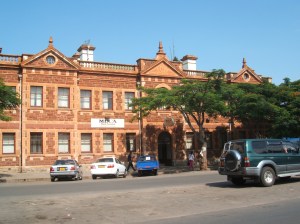
Bulawayo street

Unfortunately I’ve left writing up my December trip too late – it’s been six months and I’m departing on my motorcycle adventure tomorrow. All the same, I’ll put up some pictures of Bulawayo and the Matopos for anyone who wonders what my part of the world looks like…

Bulawayo Art Gallery

Bulawayo Architecture

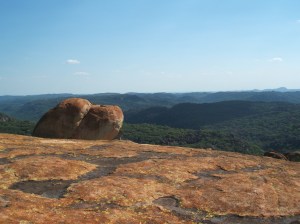
The Matopos

World's View

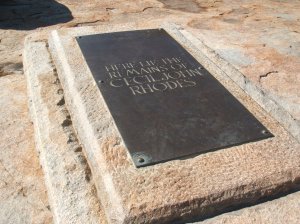
Rhodes Grave

Fair Warning

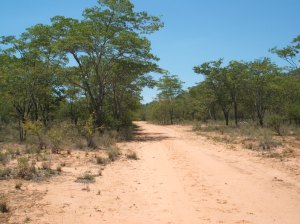
Sandy Road

Sun-downers

Posted by: Richard Marshall | December 9, 2011

Singapore and Malaysia

Singapore skyline

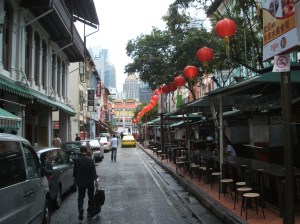
After a couple of weeks teaching I set off on my travels again during the last two weeks of October, this time to Singapore and peninsular Malaysia. I arrived at Changi airport and took Singapore’s immaculate MRT to Chinatown where I had booked a hostel. I liked the city immediately. Chinatown is really wonderful – a few blocks of the city’s old shophouses somehow survived being demolished for skyscrapers and have been turned into a neighbourhood of restaurants, cafes and shops. The area isn’t only popular with tourists – Singapore seems to be a city obsessed with food and plenty of locals were eating in the truly wonderful restaurants. Eating delicious food was a real highlight of this trip in both countries. There was also a Chinese opera being performed in front of the building which my hostel was in, and though naturally I couldn’t understand anything, the great clouds of incense and the clanging of gongs was very atmospheric.

Chinatown food street

On my second day I met up again with Irene, whom I had met in Dalat two tears ago. She took me to a brewery at Clark Quay, another area of bars and restaurants just upriver from the CBD. After that we took a slightly long route to the esplanade to meet Lydia, who was also in Dalat, and her boyfriend. The esplanade is a sort of cultural complex – I saw adverts for Kevin Spacey in Richard III – and had a wonderful view over the central city. We had a tasty dinner at a hawker market – I particularly liked the carrot cake despite everyone saying it’s just fried dough – and went for a drink at Chijmes, an old convent turned into bars. The next day I wandered around the old colonial area looking at the heavy “Rule Britannia” government buildings and visited a couple of museums. That evening Irene took me to Holland Village- yet another area of trendy bars. I liked being in bars full of well-dressed young people glued to their smart phones getting a drink after work rather than the pretty motley clientele of my HCMC haunts – it really did feel like being in a western, or at least modern,  city.  Irene headed off to Cambodia the next day, but she was such a charming host I decided to cut short my Malaysia trip and return the following week. The last night before I left I met up with my roommate Ted’s girlfriend’s sister Thy and her husband Eddie.  Eddie is a true food enthusiast and took me to one of Singapore’s most famous Bak Kuh Teh restaurants. We had to queue to get in and the walls were covered with photos of Taiwanese and Hong Kong celebrities with the owner. White Bak Kuh Teh consists of pork ribs boiled in a white pepper soup, which doesn’t sound great but was absolutely delicious. Even the pig’s organ – kidney, liver and intestine – soup was tasty though intestines do disturb me a bit. Eddie also gave me some tips on what to try in Melacca, which I duly did…
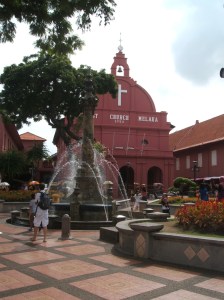
I bought a bus ticket for Melacca in a rather seedy old highrise. The shop next door was a marriage agency and the pictures of the Vietnamese women in the window had expressions that made me shudder. The bus trip to Melacca was comfortable, though the palm-oil apocalypse of southern Malaysia is pretty dismal and they insisted on playing “The Sorcerer’s Apprentice” on the TV.  I liked Melacca. For a small town it has an amazingly diverse and cosmopolitan history. Waves of different people – Malays, Arabs, Chinese, Indians, Portuguese, Dutch and British – have settled in or ruled Melacca. The town centre is mostly Dutch, aside from the ruined hilltop Portuguese fort, and some of the buildings might easily have been in South Africa. The food also reflects the town’s history, from Malay laksa soup and Hokkien chicken and rice to Goanese curries and Portuguese egg tarts.

Christ Church Melacca

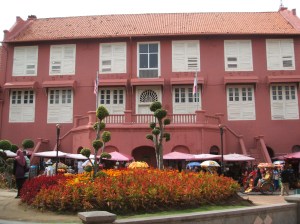
Stadthuis Melacca

After a couple of days in Melacca I headed to Kuala Lumpur. KL is an ok city – it suffered in comparison to Singapore as a tourist destination, but I suspect it would be a pretty cool place to live as an expat. I looked at the old colonial buildings which were interesting enough. Seeing a group of Indians playing cricket in front of the old city hall was a reminder  just how different Malaysia is to Indochina. I went to the Petronas towers which are indeed amazing. Unfortunately the viewing deck was closed but I found a bookshop in the mall and spent a small fortune on books. On my second day I went to the KL botanical gardens which were beautiful – why on earth couldn’t the French have established something half as good here!? The famous aviary wasn’t quite so good, being mainly full of peacocks and cattle egrets. Once again the food was the real attraction in KL. Just down from my hostel were some rough and ready Indian restaurants with curries swimming in oily gravy, mounds of stodgy bread and great heaps of Biryani – delicious! I watched a couple of tired movies at the mall near my hostel, and was happy to head back to Singapore.

KL City Hall

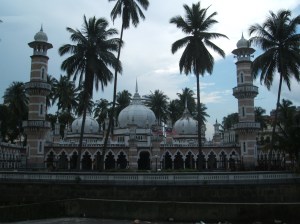
Jamek Masjid

My last few days in Singapore were mostly spent with Irene and her friends – especially Octa and Devi so hi if you’re reading this. We spent a day in the Singapore botanical gardens which are justly famous and very beautiful. Irene also took me to an alumni event at her university which since she studied management was probably the biggest culture shock of the whole trip! On my final evening we went on a Halloween bus party. The bus ferried us from one Singapore nightspot to another. We were supposed to go to five different locations but the vodka bottles being passed up and down the bus meant I needed to head home before the very end. The last place (for me) was a very fancy club built out over Marina Bay in front of the CBD – in other words the kind of place I would never, ever have gone otherwise! Oh, and we wore costumes…

Halloween costumes

The next day I attempted to cure my hangover with a big mac at the Changi budget terminal and headed back to Vietnam (Indeed, I was back as soon as I got on the plane – turning one’s cellphone off for and hour and twenty minutes was just too much for most of the passengers, and everyone stood up the second the wheels hit the tarmac!). It was a really wonderful trip – beautiful places, delicious food and especially wonderful company…I can’t wait to get back.

Posted by: Richard Marshall | October 6, 2011

Hoi An and Hue

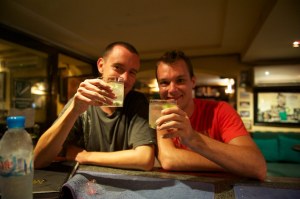
Gregor and Rich

As I prepare to head off to Singapore and Malaysia in a couple of weeks I realise it’s about time I wrote up my last trip in July. After a long period of anticipation, my friend Gregor finally strolled out of Tan Son Nhat airport ready for a two-week trip to central Vietnam. We spent the first afternoon catching up and drinking beer with a fine view of the city from the roof of the Caravelle hotel and wrapped up the evening with more beer and deep-fried soft-shelled crabs at a restaurant near my apartment. Despite a mild hangover we dutifully visited the sights in District One the next day, including heading up to the newly opened viewing deck of HCM City’s tallest building, which was very impressive. Gregor managed to pick up a couple of Rolexes at the local market and got pretty good at snapping photos off the back of a moving motorbike. Despite being a bit weary we managed to have a very long night, visiting some of my usual haunts as well as some…less familiar…establishments. The result was a truly appalling hangover for our trip to District Five the next day. District 5 is a bit intense at the best of times, but in baking heat and in our condition we struggled round a few Chinese pagodas and Binh Tay market with some difficulty! We also had to bribe a cop for driving without a licence (I have subsequently finally got my Vietnamese licence) so it was a bit of a tough day…

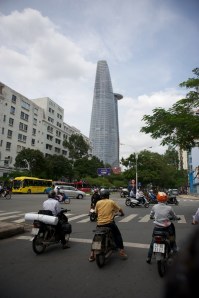
Bitexo tower

The next day we took off for Da Nang on the central coast, new territory for us both. I liked the look of Da Nang but our destination was the small town of Hoi An a few kilometres away. Hoi An is an old trading port that somehow avoided the devastation most of Vietnam’s other towns have experienced one way or another and lives on as a tourist hot spot. It really is very beautiful and although the tourist presence can be a bit overwhelming at least that is an incentive to preserve the town’s wonderful architecture. It really is a charming town and we were fortunate to find a very comfortable hotel with a view over some rice paddies, a real relief to someone as starved of green spaces as me. Hoi An also had some of the best food I’ve had in Vietnam. We found a friendly restaurant that we had to visit again and again. As well as local specialities such as Cao Lau – a pork and noodle dish – and rice paper delicacies called white roses the place fantastic spring rolls. The family who ran the place were also very charming and happy to let me practise my still pretty poor Vietnamese which no doubt requires some patience. We spent some time wandering the narrow streets of the town as well as taking a trip to the beach nearby. Gregor also got some pretty sharp suits made that I hope have been spotted on the streets of Cape Town…

Japanese bridge

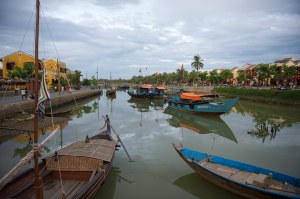
Hoi An boats

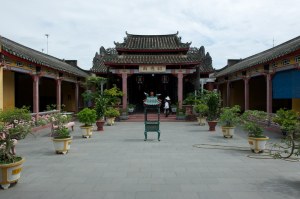
Chinese Pagoda

Our plan was to hire bikes and drive the 120km or so to Hue. We hired bikes from a fairly eccentric German – after an unsuccessful experiment with Chinese motorcycles we settled on easy-to-drive Yamahas, which performed excellently. The great attraction of the trip was going over the Hai Van pass. The pass was indeed spectacular, especially on our return journey when the sun was shining brightly. On one side are the Truong Son mountains, some of which are happily protected by the Bach Ma National Park, and on the other a great, deep-blue expanse of the South China Sea. The road winds back and forth and needed a fair bit of concentration!

Hai Van Pass

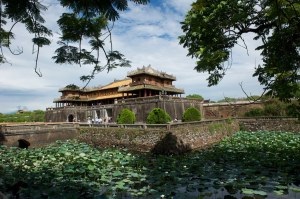
My first impression of Hue was that it was shabbier and more down-at-heel than I expected, even taking into account its disastrous twentieth-century history. One of the few places the VLF managed to hang on to for any length of time during the Tet offensive in 1968, the once gorgeous Imperial capital was utterly devastated by the Americans, yet another horrendous crime. But after a day or so the place started to grow on me. For one thing, the setting on the Perfume River with the mountains in the background really is enchanting. Also, the Imperial City is slowly being restored and has some wonderful buildings and gardens. Indeed, the restoration projects are ultimately so ambitious that one feels they should leave some of the ruins as a poignant war memorial.

Gate to the Imperial City

Throne Room at Hue

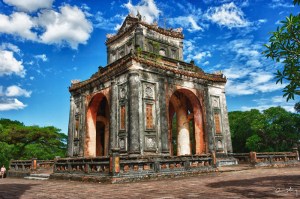
Our second day we visited some of the pagodas and imperial tombs in the vicinity. The Nguyens were the last dynasty to rule Vietnam, ending up as little better than French puppets. Although it was fun driving around the countryside the heat was unbelievable, so we only visited two of the tombs – Tu Duc, who was the longest-reigning emperor, and one of his predecessors Ming Mang, who was the last of the Nguyen emperors to really exercise independent power. The tombs were also summer palaces, built by the emperors during their lifetimes, and were large areas set in attractive parklands and gardens. Although not badly damaged during the wars, they were neglected after 1975 as monuments to a corrupt feudal past, but by now are seen as precious national treasures and are being frantically preserved.

Tu Duc’s tomb

Central Vietnam

We drove back to Hoi An and rested for a day before heading back to HCMC. By the time we got there we were burnt, tired and covered in odd scratches and bruises! The last day we took a day trip to the Mekong Delta just to have a look at the river. I hadn’t really liked it two years ago but after some heavy rain the paddies were emerald-green and the new highway made the journey much less exasperating.  It was a good ending to a really fantastic trip. Central Vietnam has some really very special places, and of course being able to experience that with an old friend meant that the trip was probably the best I’ve done so far in Asia – so thanks Gregor and get over here again sometime!!! There’s still hundreds of miles of coast road to go:)

Gregor’s a great photographer so check out his blog and his photostream...

Posted by: Richard Marshall | April 19, 2011

The Cardamoms

River in the Cardamoms

When I first went to Cambodia a year ago I read about the Cardamom Mountains in the south-west of the country and though I wasn’t sure I’d ever make it the idea appealed to me. The name alone was so wonderfully exotic that just saying “oh, I went hiking in the Cardamoms”  seemed a good enough reason to visit. Also, as the last stronghold of the Khmer Rouge the area is remote and reputedly one of South East Asia’s last real wildernesses – apparently tigers and elephants still lurk in the depths of the forests, and even if I didn’t see those at least there’d still be birds. Not having plans for Tet, I decided to set off…

I had to spend the first night in Phnom Penh as the bus south left early in the morning. I had intended to explore whatever attractions that city had to offer, but when I got there I actually couldn’t summon the strength. The fact that on my last day in HCMC some idiot had clipped the front wheel of my motorbike trying to get through a gap that was too narrow and pitched me over the handlebars onto the tarmac didn’t help. And it was really hot. And I just didn’t fancy trouping off with a mob of other tourists in dirty Thai fishing pants and dreadlocks to gawp at heaps of human skulls or pictures of murdered children grinning fatuously or staring blankly at their captors. I know that it’s important to take the Cambodian tragedy seriously, but this was a bird-watching trip. I didn’t feel like visiting the various palaces the French had built for the Cambodian kings to make them feel better about losing their country either.  Phnom Penh just gave me the creeps – the whole place is desperately poor and rotten with corruption and cruelty. The contrast with Vietnam is really striking – Phnom Penh makes HCMC seem like Paris. So instead of sight-seeing I went and drank beer at the Foreign Correspondants Club. The FCC is supposed to evoke the “glamour” of the 70s when young westerners looking for adventure could come and take photographs of South East Asians actually killing each other and not just their remains. That said, it is an attractive colonial building with a wonderful view of the Mekong, cold beer and good food, so I was happy just to relax there.

Getting to the Cardamoms turned out to be a bit of a pain. I was supposed to catch a bus to Koh Kong and then get off at a place called Andoueng Teuk half way there. After tramping around several bus stations I eventually got a ticket rather later than I hoped. Naturally the bus was over-crowded and full of children vomiting in the aisle so I wasn’t unhappy to disembark at Andoueng, hot, dusty and desolate though the place was. A foreigner comes there only for one reason, though, so it didn’t take long to find a motorbike to drive me to Chi Phat, half an hour away down a dusty road surrounded by sugarcane. Chi Phat the village where the hikes into the Cardamoms begin. The hiking is arranged by an eco-tourism NGO hoping to generate an income for the locals, and it was good to see a steady stream of tourists willing make the effort to actually get there. That said, the village is still pretty wretched. My first meal there was the worst I’ve had in Asia – some foul soup with honeycomb tripe and some thick black stuff that was – more tripe? Congealed blood? I wasn’t sure…The local guesthouse was basic but clean and private, though, and the next day I headed into the forest.

The River

I was annoyed that I seem to have forgotten how to pack for a hike. I only brought one t-shirt, which after three days not inconsiderable exercise in tropical heat was in a dreadful state. Also, my trusty boots finally let me down on the last day and I had to walk back with one sole bound up with the shoe laces. The guides cooked way too much food and after eating it for two days out of politeness I ended up a bit sick, which is pretty unpleasant in the middle of the jungle in the middle of the night. But the forest was absolutely magnificent. I was initally a bit worried as the long boat trip intially passed through areas that were decidedly settled, but eventually we genuinely were in the wilderness. I didn’t see any animals, and very few birds (though I did see the huge Great Hornbill), but the beauty of a vast expanse of forested hills was absolutely worth spending four days travelling for a three day hike. I also had very pleasant company on the first day of the trip and didn’t mind being on my own for the last two.

The trip back was as trying as the way there and I also ended up losing my binoculars on the bus which left a bit of a bad taste in my mouth. I was also stuck in Phnom Penh for a morning again when I was itching to get back home. I think I’ve had my fill of Cambodia, but that was also the most adventurous trip I’ve done here so I’m glad I made the effort.

Forest stream

Grassy clearing

« Newer Posts - Older Posts »

Categories